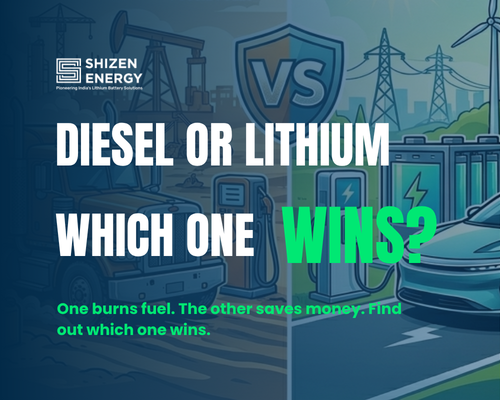
For most Indian SMEs in 2026, lithium battery backup works out 40–60% cheaper to run than a diesel generator over 5 years, especially with diesel at ₹90–100/litre and frequent power cuts in Tier 2/3 cities. When you factor in fuel, maintenance, downtime, and lifespan, a modern lithium ESS or UPS from Shizen Energy typically delivers power at a much lower cost per unit than a DG set, while also being cleaner, quieter, and easier to manage.
Diesel Generator vs Lithium Battery India 2026: Who Really Wins on Cost?
If you run an SME in India today, whether it’s a pharma unit in Baddi, a printing press in Chennai, a clinic in Pune, or a small factory in Coimbatore – you already know one thing: Power backup is non-negotiable.
What’s not so obvious is which backup is cheaper in 2026: diesel generator vs lithium battery in India.
On paper, diesel gensets look cheaper to buy. In practice, with diesel at around ₹90–100/litre, rising compliance costs, and frequent maintenance, the real cost per unit of electricity from a DG set can be 3× grid power.
By contrast, a lithium battery backup system (ESS or UPS) has a higher upfront cost but much lower running cost, longer life, and almost zero routine maintenance. Over a 5–7 year period, lithium battery backup is usually cheaper than a diesel generator for Indian SMEs, especially for businesses with 2–8 hours of backup use per day.
In this blog, we will break down:
- Which is cheaper: diesel generator or lithium battery in India (2026)?
- How to calculate your ROI and break-even point
- Real-world cost table with 2026 diesel prices and realistic backup usage
- A Chennai SME case study where Shizen lithium ESS replaced a 20 kVA DG set
- When a lithium ESS India solution makes the most business sense for you
Throughout, we’ll reference Shizen’s single phase lithium battery, three phase lithium battery, and solar inverter lithium battery solutions so you see practical options, not just theory.
Which Is Cheaper: Diesel Generator or Lithium Battery in India?
Let’s answer the core question directly, in the way AI search and voice search users ask it:
Which is cheaper: diesel generator or lithium battery in India in 2026?
For most SMEs using backup for 2–6 hours per day, a lithium battery backup is cheaper than a diesel generator over a 5-year period, typically saving 40–60% on total backup power cost.
Why?
1. Fuel cost explosion
- Diesel is around ₹90–100/litre in many Indian cities in 2026.
- A typical 20 kVA DG set consumes roughly 3.5–4 litres/hour at moderate load.
- That’s ₹315–400 per hour of backup just in fuel.
- Over a month with 60–80 backup hours, SMEs end up spending ₹15,000–₹40,000/month only on diesel.
2. Maintenance & downtime
- DG sets need servicing every 300 hours or so (oil, filters, etc.).
- You either pay an AMC or your staff waste time managing breakdowns, leaks, and noise complaints.
- Any failure during a critical production run costs you far more than the AMC bill.
3. Lithium ESS efficiency & lifespan
- A well-designed lithium ESS / UPS lithium battery from a quality manufacturer like Shizen has:
- Round-trip efficiency of 90–94%
- Lifespan of 10+ years (3000–6000 cycles, depending on usage)
- Near-zero routine maintenance
- Your primary cost is the upfront capex, distributed over thousands of cycles.
When we compare diesel genset cost per unit in India vs lithium ESS cost per unit, lithium wins for SMEs who face regular power cuts and already spend heavily on diesel.
Cost Comparison Table – Diesel vs Lithium for Indian SMEs (2026)
Let’s take a typical SME scenario:
- Backup requirement: 10 kW / 12.5 kVA
- Usage: 3 hours/day average backup (90 hours/month, 1080 hours/year)
- Location: Indian Tier 2/3 city with frequent power cuts
- Period: 5 years
Below is a simplified cost comparison between:
- Option A: 20 kVA Diesel Genset
- Option B: Shizen lithium ESS / UPS lithium battery system of equivalent usable power
Cost Assumptions (2026 realistic values)
- Diesel price: ₹95/litre (midpoint of ₹90–100)
- DG fuel consumption: 3.5 litres/hour at typical SME load
- DG servicing: every 300 hours, around ₹6,000/service (oil, filters, labour, minor parts)
- DG life: ~8–10 years (but we compute for 5 years)
-
Lithium ESS capex (for a quality business three phase UPS battery system):
- Approx ₹8–10 lakh for a 10 kW solution with adequate usable kWh (example figure; actual quote depends on sizing and brand)
- Lithium efficiency: 92% round-trip
- Lithium life: 10 years or 4000+ cycles, so 5-year window is well within life
- Maintenance: negligible (periodic inspection, minimal cost)
Now, a high-level comparison table:
| Parameter | Diesel Generator (20 kVA) | Shizen Lithium ESS / UPS System |
|---|---|---|
| Upfront Capex (approx) | ₹3.5–4.5 lakh | ₹8–10 lakh (depends on kWh & inverter sizing) |
| Fuel / Energy Cost | ~₹315–400/hour (diesel @ ₹95/litre, 3.5–4 L/hr) | ~₹9–11/unit (grid power for charging + minor losses) |
| Monthly Running Cost (90 hrs) | ₹28,350–36,000 (fuel only) | ₹9,000–11,000 (assuming ~10–12 units/day backup) |
| Annual Fuel/Energy Cost | ₹3.4–4.3 lakh/year | ₹1.1–1.3 lakh/year |
| 5-Year Energy Cost | ₹17–21.5 lakh | ₹5.5–6.5 lakh |
| Maintenance & AMC (5 years) | ₹1.0–1.5 lakh | ~₹15,000–₹25,000 (inspection, minor checks) |
| Noise & Fumes | High (complaints, NOC, ventilation) | Silent, no fumes |
| Compliance & Space | Needs exhaust, ventilation, diesel storage norms | Compact indoor-friendly design |
| Typical Cost per Unit (5-year view) | Often ₹35–45/unit or more | Often ₹12–18/unit, depending on usage pattern |
From this table, you can see why lithium battery backup is cheaper than a diesel generator in India over a 5-year window, even though the DG seems cheaper upfront.
This is exactly why diesel genset replacement with lithium battery in 2026 has become a serious conversation among SME owners, facility managers, and EPC companies.
Break-Even Calculator – When Does Lithium Pay Off?
The biggest hesitation SME owners have is: “Lithium ESS is expensive. When will I get my money back?”
Let’s build a simple mental calculator you can adapt with your actual numbers.
Step 1 – Calculate your monthly diesel cost
Use this formula:
Monthly Diesel Cost = Backup Hours/Month × Diesel Consumption (L/hour) × Diesel Price (₹/litre)
Example (20 kVA DG set):
- Backup hours/month: 90
- Diesel consumption: 3.5 L/hour
- Diesel price: ₹95/litre
Monthly diesel cost = 90 × 3.5 × ₹95 = ₹29,925
So you are spending about ₹30,000/month only on diesel.
Step 2 – Add maintenance & attendant overhead
- DG servicing every 300 hours at ₹6,000
- 90 hours/month ⇒ 1080 hours/year ⇒ about 3–4 services/year
- Annual servicing: ₹18,000–₹24,000 (plus unplanned breakdowns)
- Attendant/time cost: even if you ignore it financially, it’s a real business overhead.
Spread over the year:
- Maintenance cost/month: ₹1,500–₹2,000
- So total monthly DG running cost: ₹31,500–₹32,000+
Step 3 – Compare with lithium ESS cost
Now assume a Shizen lithium ESS / UPS lithium battery sized for the same load:
- You charge it from the grid (or existing solar)
- Effective cost of backup units from grid: ~₹9–11/unit
- For 3 hours/day at 10 kW, your backup energy is roughly 30 kWh/day ⇒ ~900 kWh/month
- Energy cost: 900 × ₹10 ≈ ₹9,000/month
Add negligible maintenance (take ₹500–₹1,000/month equivalent):
- Total lithium ESS running cost: ₹9,500–₹10,000/month
Step 4 – Calculate monthly savings
From the example:
- DG running cost: ~₹31,500/month
- Lithium ESS running cost: ~₹10,000/month
Monthly savings ≈ ₹21,500
Step 5 – Estimate break-even period
If your lithium ESS capex is about ₹9 lakh, and you save ₹21,500/month, then:
Break-even period = ₹9,00,000 ÷ ₹21,500 ≈ 42 months (about 3.5 years)
So, in this real-world scenario:
- Break-even: ~3–3.5 years
- Remaining life of the system (up to 10 years) gives you pure savings
- Over 7–8 years, total savings can reach ₹10–15 lakh or more
This is why lithium battery ROI in India for business is increasingly compelling, especially for SMEs that currently spend ₹15,000–₹40,000/month on diesel.
If you want a precise calculation for your load and usage hours, the next logical step is:
CTA: Calculate your savings with Shizen lithium ESS — Get Free Quote
Shizen’s team can size a solution based on your existing DG set, usage pattern, and location.
Pros and Cons – Diesel Genset vs Lithium ESS / UPS for SMEs
A fair comparison builds trust. Let’s break down BESS vs DG set in India across key dimensions.
Diesel Generator – Pros
- Lower upfront capex than lithium
- Familiar technology, easy to source from local vendors
- Can run indefinitely as long as diesel is available
- Perceived as “tried and tested” by many SMEs
Diesel Generator – Cons
- High and rising running cost with rising diesel prices in India 2026
- Total diesel genset cost per unit in India is often 3× grid power
- Frequent maintenance every 300 hours; breakdown risk
- Noise, vibration, and toxic fumes – problematic for clinics, offices, commercial buildings
- Compliance headaches: NOCs, pollution norms, storage of diesel, urban restrictions
- Not aligned with clean energy backup India regulations and expectations
For businesses in Tier 2/3 cities with unreliable grid power, the ongoing cost is painful. Many SMEs quietly accept this cost because they don’t see the full 5-year cost picture.
Lithium ESS / UPS – Pros
- Much lower running cost when charged from the grid or solar
- High efficiency and long lifespan (3000–6000 cycles)
- Almost silent operation, no fumes — ideal for commercial buildings & office complex facility managers
- Very low routine maintenance; no fuel handling, no filters, no oil
- Perfect partner for solar inverter lithium battery India installations
- Compact footprint; can be installed indoors safely
- Helps businesses align with clean energy backup India and ESG goals
This is why lithium battery backup is cheaper than a diesel generator India in most SME use cases over a few years.
Lithium ESS / UPS – Cons
- Higher upfront investment than DG sets
-
ROI depends on how often you use backup:
- If you rarely face power cuts, DG might still be adequate
- Requires proper design, sizing, and quality; going too cheap on lithium can cause issues
- Some SMEs are unfamiliar with the tech, so trust and education is needed
A well-engineered solution from a reputed UPS lithium battery manufacturer like Shizen reduces these risks significantly.
Real Use Case – Chennai SME Replaces 20 kVA DG with Shizen ESS
To make things concrete, here’s a realistic story based on typical SME patterns:
The Business
- Type: Packaging & printing SME
- Location: Chennai (industrial suburb)
- Load: ~12 kW, previously supported by a 20 kVA DG set
- Power cuts: 2–4 hours daily on average, worse in summer
Before – Diesel Genset Costs
- Monthly backup hours: ~80–100 hours
- Diesel consumption: ~3.5 L/hour
- Diesel price (2026): ~₹95/litre
Monthly fuel cost:
- Low month: 80 × 3.5 × 95 ≈ ₹26,600
- High month: 100 × 3.5 × 95 ≈ ₹33,250
Average: ~₹30,000/month on diesel
Add AMC & servicing:
- 3–4 services/year: ~₹18,000–₹24,000
- Effective additional: ~₹1,500–₹2,000/month
Total monthly DG cost: ₹31,500–₹32,000
They also faced:
- Noise complaints from neighbors
- Occasional breakdowns leading to lost production
- Fumes and heat in the DG room
After – Shizen Lithium ESS
They installed a Shizen lithium ESS:
- Solution: Three phase UPS battery India solution (around 10–15 kW)
- Integrated with grid and pre-existing rooftop solar (hybrid setup)
- Sourced from Shizen Energy India, a leading lithium ESS India manufacturer
Now:
- Backup power comes from lithium ESS charged via solar + grid
- Diesel generator is kept only as an extreme emergency backup (rarely used)
Monthly costs changed as follows:
- Effective backup units/month: ~900–1000 kWh
- Cost via grid/solar + ESS losses: ₹9,000–₹11,000/month
- Maintenance: negligible; basic inspections only
Year 1 savings:
- Previous DG cost: ~₹3.8 lakh/year
- New ESS running cost: ~₹1.2 lakh/year
- Net saving: ≈ ₹2.6 lakh–₹2.8 lakh in Year 1 alone
So a Chennai SME replaced their 20 kVA DG set with Shizen ESS and saved ~₹2.8 lakh in the first year while eliminating noise and fumes. Over 5 years, they expect to save well over ₹10 lakh compared to a pure diesel genset strategy.
For solar installers and EPCs, this kind of project also shows the value of pairing PV with a solar inverter lithium battery India solution rather than pushing DG sets.
Where Lithium ESS Makes the Most Sense in India?
Lithium ESS isn’t for everyone. But it’s a strong fit for:
- Factory owners currently using DG sets as primary backup
- Commercial building & office complex facility managers facing noise/fume complaints
- Tier 2/3 city businesses where power cuts are still frequent
- Solar installers & EPC companies searching for a reliable ESS partner
- SMEs in sectors like pharma, food, printing, clinics, cold storage, where power quality matters
In these segments, diesel generator vs lithium battery India is no longer just a theoretical comparison. It’s an immediate business decision driven by cost and compliance.
Shizen offers:
- ESS HV systems for larger industrial loads
- Single Phase UPS lithium batteries for clinics, small offices, and retail
- Three Phase UPS lithium batteries for factories and commercial complexes
- Solar inverter lithium battery packs for hybrid and off-grid lithium solution India projects
If you’re planning a diesel genset replacement with lithium battery 2026, these are the categories you will explore.
How to Decide – A Simple Framework for SME Owners?
Here is a straightforward way to decide whether lithium battery backup is cheaper than diesel generator for your specific SME.
1. Measure your current DG usage
Write down:
- kVA rating of your DG set
- Average backup hours per day
- Diesel consumption per hour
- Monthly diesel spend (from bills or estimates)
- Annual maintenance spend (AMC + breakdowns)
If your monthly diesel spend is ₹15,000–₹40,000, you are exactly the target profile that benefits from a lithium battery ROI India business analysis.
2. Estimate potential lithium ESS cost
You don’t need exact numbers to start. Ask:
- What is my maximum simultaneous load (kW)?
- How many hours of backup do I truly need for critical loads?
A Shizen engineer can use this to propose:
- A single phase lithium battery solution for smaller shops and clinics
- A three phase lithium battery or ESS HV system for factories and mid-size plants
3. Compare 5-year cost, not upfront price
This is crucial. Don’t compare:
- DG: ₹4 lakh
- Lithium ESS: ₹9 lakh
Instead compare:
- DG: ₹4 lakh capex + ₹3–4 lakh/year running for 5 years
- Lithium ESS: ₹9 lakh capex + ~₹1–1.3 lakh/year running for 5 years
Once you see the 5-year total, the BESS vs DG set India equation becomes clear.
4. Consider non-financial benefits
- No noise complaints
- No diesel theft/leaks/smell
- Cleaner brand perception (important for clinics, retail, and pharma)
- Compliance risks reduced
- Integration with solar – you can grow towards an off-grid lithium solution India profile
Why Partner with Shizen Energy India for Lithium ESS & UPS?
Shizen Energy India Private Limited, established in 2019, has rapidly grown into a leading lithium battery pack manufacturer. We specialise in:
- EV batteries (golf cart, e-rickshaw, e-scooter, e-boat lithium batteries)
- Energy storage systems (single phase lithium battery, solar inverter lithium battery, three phase lithium battery)
- Material handling equipment batteries (forklift, scissors lift, stacker, tow truck, AGV lithium batteries)
For SMEs and commercial customers, our focus areas include:
- Lithium ESS India solutions for factories and commercial buildings
- UPS lithium battery manufacturer capabilities for mission-critical loads
- Integration with solar for clean energy backup India
- Support for SME energy storage system Chennai and other high-demand regions across India
We design systems to maximise lithium battery ROI for India business, ensuring your investment pays back through lower diesel genset cost per unit India, reduced downtime, and smoother operations.
If you’re evaluating diesel generator vs lithium battery India and want to see real numbers for your site:
CTA: Calculate your savings with Shizen lithium ESS — Get Free Quote
FAQs – Diesel Generator vs Lithium Battery India 2026