India’s ₹18,100 Crore Battery Push: Why ‘Made in India’ Lithium Batteries Are the Smarter Buy in 2026
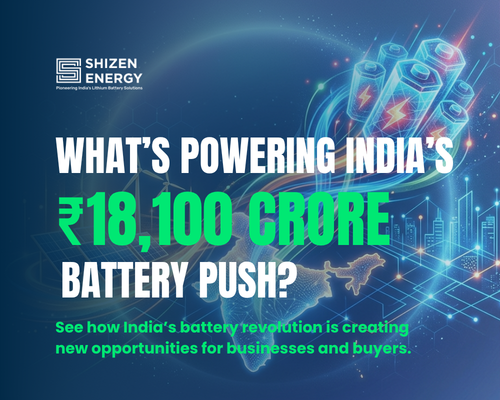
India’s ₹18,100 crore battery push is transforming the lithium battery ecosystem, making Made in India lithium battery solutions more competitive, reliable, and future-ready. For EVs, solar, and industrial applications, domestic batteries now offer stronger supply chain resilience, better local support, and long-term cost advantages, especially when backed by specialist manufacturers like Shizen Energy India, a leading lithium battery pack manufacturer for EV, energy storage, and material handling applications.
Key Takeaways
- India’s large policy push (including PLI schemes for batteries) is rapidly strengthening domestic lithium-ion manufacturing and assembly.
- Choosing Made in India lithium batteries reduces import dependence, logistics risk, and long-term ownership costs.
- Quality, warranty, and after-sales support are often more transparent and reliable with domestic lithium battery manufacturers in India.
- Shizen Energy India provides EV, ESS, and industrial lithium battery packs designed for Indian conditions, backed by local engineering and support.
What Is India’s ₹18,100 Crore Battery Push and Why Does It Matter for Buyers?
India’s multibillion-rupee battery push refers to government-backed investment and incentive programs aimed at building a robust domestic lithium battery ecosystem from cell manufacturing to battery pack assembly. For buyers, this means more local choice, better pricing stability, and access to Indian-made EV and energy storage batteries that are designed, certified, and supported within the country.
India has set ambitious targets for electrification and renewable energy adoption. To reach them, the country must reduce dependence on imported lithium cells and packs and build a strong domestic base for battery manufacturing, cell production, and battery pack assembly.
Government initiatives such as PLI scheme battery manufacturing programs and advanced chemistry cell (ACC) incentives are designed to encourage investment in gigafactories, localized supply chains, and technology partnerships under Make in India and Atmanirbhar Bharat visions.
For EV manufacturers, solar EPC companies, fleet operators, and industrial buyers, this is not just policy news, it directly affects procurement decisions, lifecycle costs, and the long-term resilience of their energy infrastructure.
How Does India’s Battery Push Strengthen ‘Made in India’ Lithium Batteries?
India’s battery initiatives support domestic cell manufacturing, pack assembly, and R&D, allowing Made in India lithium battery brands to offer more competitive pricing, tailored designs for Indian use cases, and faster innovation cycles especially in EV batteries, energy storage systems, and industrial equipment power solutions.
India’s push is creating a layered ecosystem:
- Cell Manufacturing: ACC battery projects and gigafactories aim to produce lithium-ion and Lithium Iron Phosphate (LFP) cells locally.
- Battery Pack Assembly: Domestic players integrate cells into EV batteries, Solar Battery packs, and industrial batteries using advanced Battery Management Systems (BMS).
- Application-Specific Engineering: Manufacturers like Shizen Energy design packs for specific use cases, golf carts, e-rickshaws, forklifts, solar inverters, and automated guided vehicles (AGVs).
As capacity grows, Indian manufacturers are able to optimize designs for local temperature ranges, grid conditions, and usage patterns, rather than importing generic battery packs built for other markets. This improves performance, reliability, and safety for Indian buyers.
Why Are ‘Made in India’ Lithium Batteries a Smarter Buy Than Imported Ones in 2026?
In 2026, Made in India lithium batteries are often the smarter choice because they mitigate currency and import risks, offer faster delivery and service, and are engineered for Indian operating conditions. When sourced from a domestic lithium battery manufacturer India like Shizen Energy, buyers gain clearer warranties, easier technical support, and better total cost of ownership.
The traditional assumption was that imported batteries are always superior. In 2026, that’s no longer automatically true. India’s domestic ecosystem has matured rapidly across EV, solar, and industrial segments. Some of the key advantages of choosing Made in India EV battery and ESS solutions include:
- Price Stability: Reduced exposure to currency fluctuations and global freight spikes.
- Supply Chain Resilience: Shorter lead times and lower risk of shipment delays or port bottlenecks.
- Local Optimization: Pack designs tuned for Indian roads, heat, dust, and grid variability.
- After-Sales Support: Easier access to service centers, engineers, and spare parts.
- Compliance and Traceability: Clear alignment with Indian BIS Certification, IEC Standards, and local safety norms.
For EV manufacturers, solar EPCs, and industrial OEMs, the smarter buy is often the one that balances upfront cost with reliability, uptime, and long-term support. That’s precisely where high-quality Indian manufacturers now compete strongly.
Imported vs. Made in India Lithium Batteries – What’s the Real Difference?
Imported batteries can sometimes offer niche chemistries or brand prestige, but they come with higher logistics risk, complex warranties, and rising import costs. Made in India lithium batteries, when sourced from credible manufacturers, match global standards while delivering stronger local support, predictable supply, and better lifecycle economics.
Comparison Table: Imported vs. Made in India Lithium Batteries (2026)
| Factor | Imported Lithium Batteries | Made in India Lithium Batteries |
|---|---|---|
| Price Stability | Sensitive to forex, freight, duties | More predictable, aligned with local cost structures |
| Lead Times | Longer, affected by global logistics | Shorter, local warehousing and assembly |
| Customization | Limited; built for global markets | High; tuned for Indian EV, solar, and industrial loads |
| Warranty & Service | Complex, cross-border claims | Clear local terms, faster resolution |
| Compliance | May follow foreign norms | Aligned with BIS/IEC and Indian safety requirements |
| Supply Chain Disruption Risk | Higher, due to global shocks | Lower, with localized sourcing and pack assembly |
| Long-Term Support | Dependent on overseas partners | Direct access to domestic engineering teams |
For procurement managers and fleet operators weighing options, the choice is less about “India vs. the world” and more about total value. When domestic manufacturers demonstrate robust Battery Manufacturing quality, strong BMS integration, and credible certifications, Made in India lithium battery solutions often come out ahead.
How Do Government Incentives Like PLI Impact Battery Pricing and Availability?
The PLI scheme battery manufacturing incentives encourage investment in Indian gigafactories and pack assembly units, which expands supply and gradually reduces per-kWh costs. While immediate price drops may be modest, the real impact is more stable availability, competitive local pricing, and better bargaining power for Indian buyers over the medium term.
PLI schemes and ACC initiatives are structured to reward capacity creation and performance. As more players invest and scale up:
- Per-Unit Costs Decline: Fixed investments are spread over larger volumes, reducing cost per battery pack.
- Local Competition Increases: More lithium ion battery manufacturing company India entrants push innovation and pricing discipline.
- Technology Partnerships Grow: Indian firms collaborate with international cell makers, improving chemistry and BMS sophistication.
Buyers benefit not just through potential discounts, but via stronger negotiating positions, diversified suppliers, and easier access to locally manufactured EV and ESS packs.
Are Indian-Made Lithium Batteries Reliable in Terms of Quality and Safety?
Yes, when sourced from manufacturers that follow stringent quality processes, adhere to BIS certification and IEC standards, and integrate advanced Battery Management Systems, Indian-made lithium batteries can deliver reliability on par with global brands, with the added advantage of localized support.
Quality concerns are a key pain point. The reality is that battery reliability depends more on engineering discipline and process control than country of origin. Key indicators of dependable Indian batteries include:
- Chemistry Choice: Proven chemistries like LFP (Lithium Iron Phosphate) for EVs and ESS, known for safety and cycle life.
- Robust BMS: Intelligent Battery Management System for cell balancing, thermal control, and protection.
- Manufacturing Standards: Strict QC, controlled environments, and traceable batch records across Battery Pack Assembly stages.
- Compliance: Adherence to relevant IEC standards and Indian regulatory requirements.
Shizen Energy India focuses on these pillars to manufacture golf cart, e-rickshaw, e-scooter, and e-boat EV batteries, as well as single-phase and three-phase inverter batteries and industrial packs for forklifts and AGVs. The result: batteries engineered for safety, performance, and longevity in Indian conditions.
How Does Shizen Energy Support EV and Energy Storage Buyers in India?
Shizen Energy India acts as a specialized domestic lithium battery manufacturer India, offering application-specific packs for EVs, energy storage systems, and industrial material handling equipment—backed by engineering consultation, warranty support, and reliable supply for Indian OEMs, fleet operators, and EPCs.
Established in 2019, Shizen Energy India Private Limited has built expertise in designing and assembling high-performance lithium battery packs for three key segments:
-
EV Battery Solutions
- Golf cart lithium battery packs
- E-rickshaw lithium batteries
- E-scooter lithium batteries
- E-boat lithium batteries
-
Energy Storage System (ESS) & Solar Batteries
- Single-phase lithium batteries for home inverters
- Solar inverter lithium batteries for residential and commercial use
- Three-phase lithium batteries for higher-load applications
-
Material Handling & Industrial Equipment Batteries
- Forklift lithium batteries
- Scissors lift lithium batteries
- Stacker lithium batteries
- Tow truck lithium batteries
- Automated Guided Vehicle (AGV) lithium batteries
By combining cutting-edge battery technology with local support and strategic partnerships, Shizen Energy helps Indian businesses move from generic imports to tailored, Made in India EV battery and ESS solutions that align with their operational realities.
What Should Buyers Look for When Choosing a Made in India Lithium Battery?
Buyers should look beyond price and check chemistry, certifications, BMS quality, warranty terms, and the manufacturer’s specialization. A structured checklist helps ensure that the Made in India lithium battery they choose offers long-term value, safety, and reliability.
Buyer Checklist: Evaluating Indian Lithium Battery Suppliers
-
Application Fit
- Is the battery designed specifically for EV, solar, or industrial equipment?
- Does the manufacturer have proven deployments in that segment?
-
Chemistry & Design
- Is LFP or another stable chemistry used where appropriate?
- Is the robust and proven? Battery Management System
-
Certifications & Standards
- Does the product comply with requirements? BIS certification
- Are relevant met for performance and safety? IEC standards
-
Warranty & Support
- Are warranty terms clearly documented and locally enforceable?
- Is after-sales service accessible, with trained technicians?
-
Supply Chain & Lead Times
- Can the manufacturer reliably deliver at your required scale?
- Is there local stock or rapid assembly capability?
-
Lifecycle Costs
- What is the expected cycle life and degradation profile?
- How do replacement and maintenance costs compare with imports?
Shizen Energy encourages buyers to use such criteria and offers consultation to help EV manufacturers, EPCs, OEMs, and fleet operators identify the right battery configuration for their use case.
How Do ‘Made in India’ Batteries Help with Supply Chain Disruptions and Rising Import Costs?
Localizing battery procurement with Made in India lithium battery suppliers significantly reduces exposure to global shipping disruptions, duty hikes, and forex volatility. For businesses with large fleets or critical power systems, domestic sourcing enhances continuity and eases planning.
Recent years have shown how vulnerable global supply chains can be. For battery buyers, the risks are tangible:
- Port Delays and Container Shortages
- Sudden Freight Price Spikes
- Regulatory Changes in Exporting Countries
By aligning with domestic lithium battery manufacturer India partners, companies can secure:
- Shorter and more predictable lead times
- Easier inventory coordination and forecasting
- Better alignment with Indian policy frameworks and incentives
For fleet operators and industrial buyers, continuity of operations often matters more than small price differences. Domestic battery sourcing supports that continuity.
Where Do Sustainability and Recycling Fit into India’s Battery Story?
Sustainability is becoming central to India’s battery push, with growing focus on battery recycling, second-life applications, and environmentally responsible supply chains. Choosing Made in India lithium batteries from responsible manufacturers makes it easier to engage in local recycling and end-of-life programs.
Lithium batteries are core to the Clean Energy transition, but that transition must be sustainable. As India scales up EVs and ESS, focus areas include:
- Battery Recycling: Recovering valuable materials and reducing landfill impact.
- Second-Life ESS: Using retired EV batteries in stationary Energy Storage Systems.
- Responsible Manufacturing: Minimizing waste and emissions in Battery Manufacturing and pack assembly.
Manufacturers like Shizen Energy, who are committed to sustainability, can support customers with guidance on safe handling, recycling channels, and lifecycle planning—helping businesses align with ESG targets and Atmanirbhar Bharat battery goals.
Practical Buyer Advice – How Should Businesses Procure Lithium Batteries in 2026?
In 2026, businesses should adopt a strategic procurement approach: favor credible Made in India lithium battery suppliers for core applications, use multi-year planning to hedge against cost fluctuations, and evaluate partners not just on price but on engineering capabilities, certifications, and long-term support.
For EV manufacturers, solar EPCs, OEMs, and industrial buyers, practical steps include:
- Segmented Procurement: Match battery types and suppliers to specific applications (e.g., one partner for EV packs, another for large ESS).
- Technical Due Diligence: Evaluate BMS architecture, safety features, and cycle-life data, not just nameplate capacity.
- Long-Term Contracts: Lock in supply with trustworthy Indian partners to stabilize availability and pricing.
- Portfolio Diversification: Maintain a mix of domestic suppliers to reduce single-vendor risk while still leveraging local benefits.
Shizen Energy works with clients to define technical specifications, simulate performance under real-world loads, and design battery solutions that optimize both capex and opex over the lifecycle.
FAQ – Made in India Lithium Batteries
Yes. Many Made in India EV battery solutions use LFP chemistry and advanced BMS, offering robust cycle life and safety that suit commercial fleets, provided they are sourced from experienced manufacturers specializing in EV packs.
Check for relevant BIS certification, IEC standards compliance, documented test data, real-world deployments in your segment, and transparent warranty and service policies. Visiting the facility and speaking with their engineering team can provide further assurance.
Partner with Shizen Energy for Made in India Lithium Battery Solutions
India’s ₹18,100 crore battery push is reshaping how energy is stored, moved, and managed across the country. For EV manufacturers, solar EPCs, OEMs, distributors, fleet operators, and industrial buyers, the opportunity is clear: shift from import-heavy procurement to strategic partnerships with trusted domestic lithium battery manufacturer India brands.
Shizen Energy India Private Limited stands ready to support that transition with:
- EV battery packs for golf carts, e-rickshaws, e-scooters, and e-boats
- ESS and solar inverter batteries for single-phase and three-phase applications
- Industrial batteries for forklifts, scissors lifts, stackers, tow trucks, and AGVs
If you’re evaluating Made in India lithium battery options or planning your next phase of EV or energy storage deployment, connect with Shizen Energy’s team for a tailored technical consultation and product recommendations aligned with your operational and financial goals.