Introduction
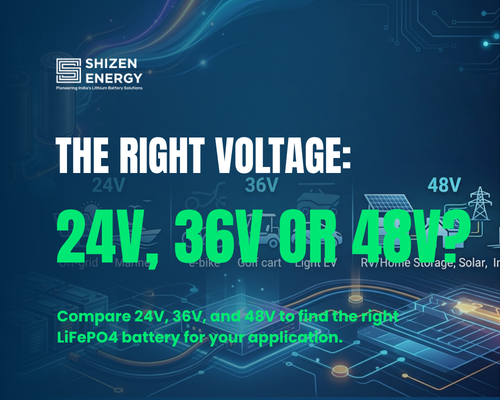
A 24V vs 36V vs 48V LiFePO4 battery choice is not just a technical decision; it directly impacts your equipment performance, runtime, efficiency, and safety. This application-based guide will help EV manufacturers, solar installers, OEMs, industrial equipment makers, system integrators, and energy storage buyers choose the right LiFePO4 battery voltage for their real-world use cases, while positioning Shizen Energy as a reliable lithium battery solutions partner.
What does 24V vs 36V vs 48V LiFePO4 battery really mean?
A 24V vs 36V vs 48V LiFePO4 battery refers to the nominal DC system voltage of the lithium iron phosphate battery pack used in your application. In simple terms:
- Voltage (V) is electrical “pressure” that drives current.
- Current (A) is the flow of electricity.
- Capacity (Ah) is how much charge the battery can store.
- Energy (Wh) is total usable energy.
Higher voltage systems (like a 48V LiFePO4 battery ) can deliver the same power with lower current, reducing cable losses and improving efficiency, especially in high-power EV, industrial, and solar inverter applications.
Which LiFePO4 voltage is right for my application?
For most buyers, the real question is: “Which voltage lithium battery to choose for my specific application?” Instead of starting with formulas, start with how you use the equipment.
In general:
- 24V LiFePO4 battery – ideal for light-duty EVs, small solar, backup, and low/medium-power DC systems.
- 36V LiFePO4 battery – a mid-range option for golf carts, small material-handling equipment, and moderate-power EVs.
- 48V LiFePO4 battery – best for high-power EVs, solar energy storage systems (ESS), industrial machines, and larger backup systems.
Below is an application mapping chart summarizing where 24V vs 36V vs 48V LiFePO4 battery packs typically fit.
Application Mapping Chart – Recommended Voltage
| Application Type | Typical Use Case | Recommended Voltage |
|---|---|---|
| Golf cart battery (EV) | 2–4 passenger golf cart | 36V or 48V |
| E-rickshaw battery (EV) | Passenger/cargo e-rickshaw | 48V |
| E-scooter battery (EV) | Low/medium power e-scooter |
48V |
| E-boat / marine battery | Small boats, trolling motors | 24V or 48V |
| Single-phase solar inverter battery | Home solar backup (1–3 kW) | 24V or 48V |
| Three-phase solar ESS | Commercial/industrial ESS (5 kW+) |
48V |
| Forklift battery | Electric forklift | 48V |
| Scissor lift battery | Aerial work platforms | 24V or 48V |
| Stacker battery | Warehouse stackers | 24V or 48V |
| Tow truck / tug battery | Industrial tow tractors | 48V |
| Automated Guided Vehicle (AGV) | Robotics, AGVs, AMRs | 24V or 48V |
| Home/office backup inverter battery | 1–5 kVA inverter systems | 24V or 48V |
| RV & marine house battery | On-board DC systems, inverters |
24V or 48V |
How do voltage, current, Ah, and Wh work together?
When choosing between a 24V LiFePO4 battery , 36V LiFePO4 battery , and 48V LiFePO4 battery , you’re really balancing voltage, capacity, and power.
- Voltage (V): System level (24 / 36 / 48V).
- Amp Hour (Ah): How long the battery can supply a given current.
-
Watt Hour (Wh): Total stored energy.
Example:- 24V, 100Ah pack → 2,400 Wh
- 48V, 100Ah pack → 4,800 Wh
Higher voltage gives more total energy for the same Ah rating. For high‑power electric vehicle battery packs or inverter batteries, 48V battery systems are more efficient because they require less current for the same power:
So a 1,000 W motor:
- At 24V → needs ≈42A
- At 48V → needs ≈21A
Lower current means less heat, smaller cables, reduced losses, and longer component life.
Where is a 24V LiFePO4 battery the best choice?
Choose a 24V LiFePO4 battery when your application is low to medium power, uses smaller motors/controllers, or is designed around 24V DC systems.
Choose 24V if:
- Your equipment is originally designed with a 24V battery system.
- You have single-phase inverters in the 1–3 kVA range.
- You need compact solar energy storage for small homes, shops, or RVs.
- You run AGVs, stackers, scissor lifts, or support systems that do not require very high power.
Typical 24V LiFePO4 battery applications:
- Small solar energy storage systems.
- RV and marine house batteries.
- Low-power industrial batteries for stackers and lifts.
- Backup inverter batteries in residential and small commercial use.
For these uses, Shizen Energy’s 24V LiFePO4 battery solutions provide reliable runtime, compatibility with 24V chargers and controllers, and easy integration into existing DC systems.
When is a 36V LiFePO4 battery a better fit?
Choose a A 36V LiFePO4 battery is a niche but powerful option, often used in golf carts and certain EV platforms where 36V motors and controllers are standard.
Choose 36V if:
- Your golf cart battery system is designed around 36V (older fleets especially).
- You have EV controllers and chargers rated specifically for 36V battery systems.
- You want a balance between current reduction (vs 24V) and cost.
Common 36V LiFePO4 battery applications:
- Golf carts and utility carts.
- Some light EVs and small tow tractors.
- Specific custom OEM platforms built on 36V DC systems.
Shizen Energy supports OEM and fleet upgrades from lead‑acid to 36V LiFePO4 battery packs, improving cycle life, reducing maintenance, and increasing range without redesigning the entire drive system.
Why is 48V often the preferred LiFePO4 battery voltage?
A 48V LiFePO4 battery is the most widely adopted voltage for modern EVs, material handling equipment, and solar energy storage systems due to efficiency, safety, and standardization.
Choose 48V if:
- You need higher power for EVs, forklifts, tow trucks, and e-rickshaws.
- You want improved system efficiency and reduced cable losses.
- Your inverter or motor controller is rated for 48V battery systems.
- You are designing a modular Energy Storage System (ESS) for solar or backup.
Typical 48V LiFePO4 battery applications:
- Electric Vehicle battery packs (e-rickshaw, e-scooter, golf cart, e-boat).
- Material handling: forklift lithium battery, tow truck battery, high-power scissor lifts.
- Solar ESS for homes, commercial rooftops, and three-phase inverter systems.
- Industrial battery systems and larger backup/inverter systems.
For these segments, Shizen Energy’s 48V LiFePO4 battery solutions deliver high performance, robust Battery Management System (BMS) integration, and compatibility with motors, controllers, inverters, and chargers used across India’s EV and solar ecosystems.
Voltage Comparison Table – 24V vs 36V vs 48V LiFePO4 battery
| Parameter | 24V LiFePO4 battery | 36V LiFePO4 battery | 48V LiFePO4 battery |
|---|---|---|---|
| Typical power level | Low to medium | Medium | Medium to high |
| Common use cases | Solar backup, RV, small lifts |
Golf cart, light EVs | EVs, forklifts, solar ESS |
| Current for same power | Highest | Medium | Lowest |
| Cable & connector size | Larger | Medium | Smaller |
| Efficiency (system) | Lower for high power | Medium | Higher |
| Typical inverter rating | 24V, small single-phase |
Limited use | 48V, larger single & three-phase |
| Motor/controller options | Limited high-power options |
EV/golf platforms | Wide EV, industrial, solar range |
| Best for | Simple systems, small loads |
Legacy EV platforms | Modern EV, industrial & ESS |
This table gives a quick overview of 24V vs 36V vs 48V LiFePO4 battery behavior in real-world applications.
How does voltage affect compatibility with motors, controllers, inverters, chargers, and BMS?
Selecting which voltage lithium battery to choose is not only about power; it’s about system compatibility :
PLI schemes and ACC initiatives are structured to reward capacity creation and performance. As more players invest and scale up:
-
Motors and Controllers:
EV motors and DC controllers are rated for specific voltages (24V, 36V, 48V). Using a mismatched voltage can cause underperformance, overheating, or complete failure. -
Inverters (Solar/Backup):
Inverters are designed for specific battery system voltages. A 48V inverter requires a 48V battery system — using 24V or 36V will not work or will be unsafe. -
Battery Management System (BMS):
Each LiFePO4 battery pack from Shizen Energy includes a BMS tuned for its voltage, capacity, and cell configuration. This protects against over-charge, over-discharge, short circuits, and temperature extremes. -
Battery Charger:
A Battery Charger must match the battery voltage (24V / 36V / 48V) and chemistry (LiFePO4). Using an incorrect charger can damage cells and BMS.
Shizen Energy designs Lithium Iron Phosphate battery systems where battery, BMS, charger, and load are fully aligned, ensuring safe operation and long life.
Installation and safety considerations for different voltage systems
When installing 24V vs 36V vs 48V LiFePO4 battery systems, keep these points in mind:
- Always confirm equipment rated voltage before selecting a battery.
- Use appropriately sized cables and connectors; higher currents (24V) require thicker cables.
- Ensure correct polarity and wiring for series/parallel connections.
- Match Battery Charger voltage and LiFePO4 profile.
- Integrate the battery with a suitable BMS, especially for high-power EV and industrial systems.
- Follow local electrical codes and OEM guidelines for DC system design.
Shizen Energy offers technical guides and OEM support to ensure safe, compliant installation of lithium battery systems across EVs, material handling, solar, and storage.
Practical selection examples – EV, solar, industrial, backup
To make LiFePO4 battery application guide more actionable, here are typical buyer scenarios:
1. EV Manufacturer – E‑rickshaw
- Requirement: 2–4 kW motor, long daily runtime, commercial duty.
- Best choice: 48V LiFePO4 battery with suitable Ah to meet daily range.
- Reason: Better efficiency, strong acceleration, standard 48V EV controllers.
2. Solar Installer – Home ESS (Single‑phase)
- Requirement: 2 kVA inverter for home backup and solar storage.
- Best choice: 24V or 48V LiFePO4 battery, depending on inverter design.
- Reason: 24V for smaller, cost-optimized systems; 48V for higher efficiency and expansion.
3. Industrial Equipment Manufacturer – Forklift
- Requirement: High-power material handling, long shifts, quick charging.
- Best choice: 48V LiFePO4 battery with high Ah (e.g., 200Ah+).
- Reason: Reduced current, robust performance, proven forklift voltage standard.
4. System Integrator – AGV Fleet
- Requirement: Compact AGVs with moderate power and long lifetime.
- Best choice: for smaller robots; for high‑speed or heavy payload AGVs.24V LiFePO4 battery48V
- Reason: Lower voltage for compact systems; 48V for efficiency and heavier duty.
5. RV & Marine User – House + Trolling Motor
- Requirement: Power lights, appliances, small trolling motor.
- Best choice: for house loads, for motors based on their rating.24V LiFePO4 battery24V or 48V
- Reason: Simplicity and safety for DC systems, plus efficiency for higher-power motors.
Battery sizing checklist before you buy
Use this checklist before finalizing a 24V vs 36V vs 48V LiFePO4 battery :
6. Confirm system voltage
- What voltage is your motor, controller, inverter, or DC bus rated for (24V / 36V / 48V)?
7. Define power requirements
- What is the peak and continuous power in watts (or kW) for your application?
8. Estimate runtime
- How many hours of operation do you need between charges?
9. Calculate required energy (Wh)
- Multiply total load power by required runtime, then size battery Wh accordingly.
10. Select voltage tier
- For low power → 24V
- Medium power → 36V or 48V
- High power / industrial / solar ESS → 48V
11. Choose capacity (Ah)
- Use Wh ÷ Voltage to find minimum Ah, then add a safety margin.
12. Verify compatibility
- Check motor, controller, inverter, Battery Charger, and BMS compatibility with chosen voltage.
13. Consider environment and duty cycle
- High‑temperature, heavy‑duty cycles may require higher‑quality cells and robust BMS, standard in Shizen Energy packs.
Need help choosing your battery voltage?
If you are still unsure which voltage lithium battery to choose , Shizen Energy’s technical team can help you:
- Map your equipment and load profile to 24V vs 36V vs 48V LiFePO4 battery options.
- Recommend optimal Ah and Wh for your specific duty cycle.
- Design custom Electric Vehicle battery, Industrial battery, and Energy Storage System (ESS) solutions.
- Ensure seamless integration with your Battery Management System (BMS), motor, controller, inverter, and charger.
Explore Shizen Energy’s LiFePO4 products , custom battery solutions , technical guides, and contact our team for customized LiFePO4 battery recommendations tailored to your application.
FAQ – 24V vs 36V vs 48V LiFePO4 battery
For most modern golf carts, a 36V LiFePO4 battery or 48V LiFePO4 battery is recommended, depending on the motor and controller rating. 48V offers better efficiency and performance for upgraded or high‑power carts.
No. Inverter batteries must match the inverter’s DC input voltage. Using a 24V battery with a 48V inverter is incompatible and unsafe. Always align the LiFePO4 battery voltage with inverter specifications.
By approaching 24V vs 36V vs 48V LiFePO4 battery selection from an application-first perspective rather than only technical specifications, you can avoid poor battery matching, ensure optimal performance, and build safer, more efficient systems. For tailored guidance, partner with Shizen Energy , your trusted LiFePO4 battery solutions provider.