Lithium Stacker Battery Price in India: Understanding Cost-to-Value
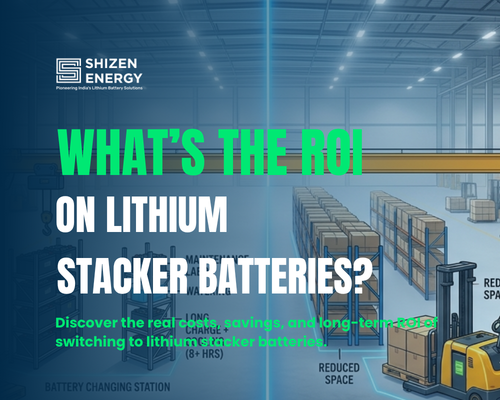
Lithium stacker battery price in India is best understood through a full cost-to-value lens, not just the upfront quote. When you factor in longer life, fast charging, minimal maintenance, and higher equipment uptime, lithium stacker batteries from Shizen Energy can deliver a strong, predictable ROI for modern warehouses.
What is the typical stacker battery price structure in India?
The stacker battery price in India is usually based on capacity (Ah), voltage, chemistry (LiFePO₄), BMS features, charging technology, and warranty coverage. Instead of a single fixed price, buyers should look at total cost of ownership (TCO), including lifespan, energy efficiency, maintenance, and downtime savings over 5–7 years.
Lithium stacker battery pricing is rarely “one number fits all.” For industrial buyers, price is shaped by technical configuration and performance expectations. Below is a practical view of how pricing is formed and why two batteries with similar voltage can have very different long-term value.
Key price drivers for lithium stacker batteries
| Factor | How it impacts stacker battery price | Why it matters for warehouses |
|---|---|---|
| Capacity (Ah) | Higher Ah = higher price | Determines run-time per charge |
| Voltage (V) | 24V, 36V, 48V systems scale cost | Must match stacker / MHE spec |
| Chemistry (LiFePO4) | Safer, long-life chemistry | Lower replacement frequency |
| Battery Management System | Advanced BMS increases cost | Protects cells, extends cycle life |
| Charging technology | Fast / opportunity charging adds cost | Cuts downtime, boosts throughput |
| Warranty & support | Longer warranty = higher upfront | Reduces risk and replacement cost |
| Certifications & compliance | Industrial and safety approvals | Required for OEM / corporate procurement |
For Shizen Energy’s lithium stacker battery and forklift lithium battery solutions, these parameters are customized to the warehouse’s fleet profile, loading patterns, and automation plans, ensuring the price reflects performance, not just hardware.

How should warehouses calculate lithium stacker battery ROI?
To estimate lithium battery ROI industrial, compare total cost of ownership (TCO) of lithium vs lead-acid over the battery’s full life. Include purchase price, energy cost, maintenance, replacement cycles, and downtime impact. Many warehouses recover the premium within 2–3 years through higher uptime, reduced maintenance, and lower replacement frequency.
A simple ROI framework:
- Initial investment: battery + charger + installation
- Annual savings: maintenance, replacement, labour, and productivity gains
- Payback period: initial investment ÷ annual savings
- Long-term ROI: total savings over 5–7 years minus full ownership cost
Illustrative ROI example (conceptual)
Assume a distribution center in India with 6 electric stackers:
- Lead-acid battery cost per unit: lower upfront, but 3–4 year life
- Lithium stacker battery cost per unit: 1.5–2x upfront, 8–10 year life
Key annual savings with lithium:
- Fewer battery changes and no equalisation charging
- Reduced maintenance (no topping up water, no frequent checks)
- Faster charging and opportunity charging during breaks
- Fewer unplanned outages and improved fleet management
Over a typical 5-year horizon, the warehouse may:
- Cut battery replacement events by 50–60%
- Reduce maintenance labour and consumables significantly
- Add 5–10% productive working hours per stacker through lower downtime
When these savings are monetised, the initial stacker battery price premium is offset, resulting in a favourable Return on Investment (ROI).
Why do lithium stacker batteries reduce total cost of ownership (TCO)?
Lithium stacker batteries reduce TCO by delivering longer cycle life, high energy efficiency, and minimal maintenance. Warehouses save on replacement costs, service labour, and downtime, while benefiting from stable performance over thousands of cycles. The end result is lower effective cost per operating hour than traditional lead-acid batteries.
Key TCO advantages:
- Cycle life : LiFePO4 chemistry often delivers several thousand cycles with consistent performance.
- Energy efficiency : Better charge–discharge efficiency cuts electricity use over time.
- Low maintenance : No water topping, acid checks, or frequent service visits.
- Stable capacity : More consistent run-time across the battery’s life.
- Reduced infrastructure stress : Less heat and no acid fumes improve environmental conditions.
When procurement managers in logistics warehouses compare warehouse equipment battery cost, they increasingly move from “lowest quote wins” to “lowest cost per productive hour,” where lithium solutions from Shizen Energy perform strongly.
How do lithium stacker batteries improve warehouse operational efficiency?
Lithium stacker batteries improve operational efficiency through faster charging, opportunity charging, stable performance, and fewer battery-related interruptions. Warehouses can run longer shifts, reduce battery swaps, and maintain higher fleet availability for electric stackers, forklifts, and other material handling equipment.
Lithium vs lead-acid: operational comparison
| Parameter | Lead-acid battery | Lithium stacker / forklift battery |
|---|---|---|
| Charging time | 6–8 hours + cool-down | 1–3 hours, fast charging options |
| Opportunity charging | Limited | Highly suitable |
| Maintenance requirements | High (water, cleaning, checks) | Very low |
| Cycle life | Moderate | High (LiFePO4) |
| Downtime risk | High due to voltage drop | Low, stable performance |
| Energy efficiency | Lower | Higher |
In busy distribution centers and manufacturing plants, lower downtime translates directly into higher throughput per shift. For example, switching to a lithium forklift battery and lithium stacker battery can:
- Reduce emergency battery swaps during peak hours
- Allow opportunity charging during lunch or loading breaks
- Support multi-shift operations with fewer spare batteries in inventory
This is where Shizen Energy industrial battery solutions align with warehouse productivity and industrial automation goals.
What are the main price factors for lithium stacker batteries? (Quick Price Factors)
Quick Price Factors: Lithium stacker battery price is shaped by capacity, voltage, LiFePO4 cell quality, smart BMS features, charging speed, warranty, and safety certifications. Customisation for specific electric stacker models and warehouse duty cycles also influences cost and long-term value.
Additional considerations:
- Integration with Battery Charger and existing charging bays
- Compatibility with Electric Stacker, Electric Forklift, and other Material Handling Equipment (MHE)
- Requirements for telematics, CAN bus, or fleet monitoring interfaces
- Corporate and OEM procurement standards for industrial battery systems
How should Indian warehouses plan battery replacement for stackers and forklifts?
Battery replacement planning starts with tracking cycle life, performance trends, and utilisation patterns. For lithium stacker and forklift batteries, replacement intervals are typically longer and more predictable. Warehouses should plan stock for critical units, align replacements with peak season schedules, and choose suppliers offering robust after-sales support.
A structured replacement strategy:
- Map all Electric Stackers and Electric Forklifts with battery specifications.
- Track operating hours and charging cycles per unit.
- Define performance thresholds for proactive replacement (e.g., noticeable capacity drop).
- Budget for staged replacements over fiscal years, prioritising high-utilisation equipment.
- Partner with a trusted Industrial Battery supplier like Shizen Energy for standardised lithium modules and support.
What is an example lithium stacker battery ROI calculation? (ROI Snapshot)
ROI Snapshot: If a lithium stacker battery costs significantly more upfront but lasts over twice as long, requires minimal maintenance, and cuts downtime by 10–15%, the payback period can often sit around 24–36 months. Beyond that, the battery continues to generate productivity and maintenance savings for the remainder of its life.
Simple ROI calculator example
Use this simplified model:
- Initial investment :
- Lithium stacker battery + charger + installation
- Annual savings components :
- Reduced maintenance cost
- Fewer battery replacements
- Lower downtime (extra pallets moved, orders picked)
- Lower energy wastage
- Annual savings (₹) = sum of all above
- Payback period (years) = Initial investment ÷ Annual savings
- ROI (%) over life =

Procurement managers can plug their own numbers (labour rates, energy price, current downtime cost) into this framework to assess lithium battery ROI industrial for their warehouse.
How does stacker battery price vary for different warehouse equipment?
Stacker battery price varies by equipment type, load profile, and voltage platform. Electric stackers, reach trucks, tow trucks, and automated guided vehicles (AGVs) may all require different battery capacities, housings, and BMS configurations. Lithium packs designed specifically for heavy-duty stacker applications command a premium but deliver higher resilience.
Typical warehouse and MHE applications for Shizen Energy’s solutions include:
- Electric Stacker & Stacker Machine Battery India
- Electric Forklift lithium packs
- Tow truck lithium battery for internal logistics
- Automated Guided Vehicle (AGV) lithium battery for industrial automation
Across these applications, Shizen Energy focuses on optimising total fleet performance rather than only minimising per-unit warehouse equipment battery cost.
Buyer checklist: How to select the right lithium stacker battery?
Use this battery selection checklist to make confident procurement decisions:
- Define equipment and duty cycle
- Type: electric stacker, electric forklift, tow truck, AGV
- Daily operating hours, shifts, and peak loads
- Specify electrical requirements
- Voltage and Ah rating
- Connector type and physical constraints
- Assess BMS and safety features
- Over-charge, over-discharge, and temperature protection
- Cell balancing and event logging
- Evaluate charging strategy
- Standard vs fast charging
- Need foropportunity charging
- Verify certifications and compliance
- Industrial safety approvals
- OEM compatibility
- Compare warranties and service
- Years covered and cycle guarantees
- On-site support and replacement policies
- Review total cost of ownership (TCO)
- Energy cost, maintenance, replacement cycles, downtime impact
- Check supplier credibility
- Experience with fleetsMaterial Handling Equipment
- Case studies in logistics warehouses and distribution centers
Shizen Energy supports procurement teams through this entire checklist, ensuring each lithium stacker battery and forklift lithium battery is configured and priced for long-term performance.
Warehouse use cases: How do logistics centers benefit from lithium stacker batteries?
Warehouses and distribution centers benefit from lithium stacker batteries through higher utilisation of equipment, smoother workflows, and reduced battery-related interruptions. Real-world scenarios commonly include multi-shift operations, cross-docking hubs, and manufacturing plants with continuous line feeding.
Typical use cases:
- A logistics warehouse that moves from single-shift to multi-shift operations without adding extra battery inventory, thanks to fast charging.
- A distribution center that reduces battery swap downtime, enabling more pallets to be handled per shift.
- A manufacturing plant that integrates Industrial Battery telematics with Fleet Management systems for real-time visibility on stacker performance.
- An OEM or Material Handling Equipment dealer offering lithium-powered stackers and forklifts with Shizen Energy packs as a premium, high-value option.
In each case, the true measure is not just the stacker battery price, but how that battery contributes to throughput, safety, and automation goals.
FAQ: Lithium stacker battery price and ROI in India
Lithium stacker batteries use advanced LiFePO4 chemistry, smart BMS systems, and fast-charging technology, which increases upfront cost. However, their longer cycle life, low maintenance, and improved energy efficiency significantly reduce the total cost of ownership over time.
Combine battery purchase price with installation, charger cost, expected lifespan, energy usage, maintenance, and downtime impact. This gives a complete TCO view, allowing you to compare different suppliers and technologies beyond just the initial quote.
In many Indian warehouses, ROI appears within 2–3 years, depending on utilisation intensity and existing lead-acid issues. High-usage fleets with frequent battery swaps and downtime usually see faster payback when switching to lithium.
Yes, when properly specified. Shizen Energy designs lithium battery packs for stackers, forklifts, tow trucks, scissor lifts, stackers, and AGVs, ensuring compatibility with voltage, connectors, and operating profiles.
Evaluate technical specifications, BMS sophistication, warranties, industrial certifications, after-sales support, and proven case studies. Choosing a supplier like Shizen Energy with deep industrial experience can reduce procurement risk and ensure long-term performance.
Shizen Energy India: Your partner in industrial lithium battery ROI
For warehouse owners, logistics companies, manufacturing plants, and distribution centers, the real value of a lithium stacker battery lies in uptime, safety, and long-term savings—not just the initial stacker battery price.
As a leading lithium battery manufacturer in India, Shizen Energy provides:
- High-performance Lithium Stacker Battery and Lithium Forklift Battery solutions
- LiFePO4-based packs with advanced Battery Management Systems (BMS)
- Custom configurations for stackers, forklifts, tow trucks, scissor lifts, stackers, and AGVs
- End-to-end support for sizing, selection, installation, and fleet optimisation
If you are planning to upgrade your warehouse or MHE fleet, treat your next battery purchase as a strategic investment, not an isolated expense. Request a customised industrial lithium battery recommendation or quotation from Shizen Energy India for your stackers, forklifts, and warehouse equipment. Their team can help you model TCO, evaluate ROI, and design a battery solution that powers your warehouse toward a greener, more efficient future.