Welcome to the world of instant backup and seamless failover. As our lives and businesses become increasingly digitized and mission-critical, having an uninterrupted power supply is no longer an option, but a necessity. But as the volume of data centers, hospitals, banks, telecom networks, edge computing, industrial control rooms, IT infrastructure, and Internet of Things (IoT) devices skyrockets, the traditional lead-acid UPS batteries are struggling to keep up with the demand for faster, smarter, longer-lasting, and environmentally sustainable backup.
Must-Know About Lithium Battery Backup Systems for UPS:
1. Short charging time for lithium UPS batteries and lithium battery backup systems for UPS is a game-changer. Lithium-ion batteries can recharge 4x faster than lead-acid batteries. That means a lithium UPS battery solution can go from 0% to 80% charge in under 2 hours, compared to 8–12 hours for lead-acid UPS backup solutions. That shorter recharge time means a lithium battery for UPS is ready to keep providing backup at the next power event or power failure. There is much less risk of equipment damage and downtime with the next-gen lithium battery UPS systems.
2. A long-life UPS battery pack means less hassle and worry. Lead-acid UPS batteries typically last only 500–1,000 charge/discharge cycles, or about 3–5 years of service before replacement is required. In contrast, lithium batteries can last for 3,000–5,000 charge/discharge cycles or about 8–10 years. This translates to fewer UPS battery replacements, less e-waste, and a better backup power strategy that is also good for green initiatives.
3. Space is always at a premium in telecom closets, server rooms, control rooms, and industrial automation panels. It is one of the key benefits of lithium UPS batteries that these lighter and compact lithium battery backup systems are up to 60% lighter and 40% smaller than lead-acid alternatives. This makes lithium batteries easier to retrofit and ideal for rack-mounted UPS as well as lightweight backup units. The reduced weight also translates into a lower structural load, and less strain on columns and beams in the building.
4. Built-in Battery Management System or BMS of lithium UPS batteries with real-time monitoring is a big win for safety. The BMS constantly monitors the battery’s health and performance to ensure it operates within its safe limits. BMS-equipped lithium batteries also come with thermal, overload, and short circuit protection. The BMS will automatically disconnect the battery if it detects any unsafe operating conditions. This is a big deal if you have 24/7 mission-critical systems. These features make lithium UPS batteries a much safer and more reliable choice, particularly in high-risk environments such as hospitals or telecom networks.
Lithium Battery Backup Systems for UPS: Features and Benefits
In a recent survey by online education platform Simplilearn, experts predicted that 5G, automation, and artificial intelligence will boost the growth of data centers, requiring approximately $600 Billion in spending through 2026. This, in turn, will increase the need for both uninterruptible power supply (UPS) and rapid-charging lithium UPS batteries in order to keep data center operations online and protected.
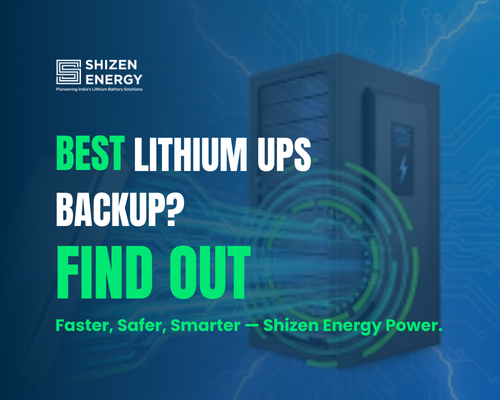
Best Lithium UPS Batteries (Lithium Battery Backup Systems for UPS): Smarter, Faster & Safer.
1.Shizen Energy India – ESS-48V100AH Lithium UPS Battery

Fast charging, high energy density, and in-built smart safety management system are the hallmark of Shizen Energy India’s lithium battery UPS.
Already installed and supporting IT infrastructure, data centers, telecom and government, industrial automation, and healthcare, our lithium battery for uninterrupted power supply is safe, reliable, and field-proven. The lightweight and compact Lithium UPS Battery are ideal for single-phase UPS, three phase UPS battery banks, solar inverter UPS backup, and solar power bank UPS retrofit.
2. Delta Electronics – Ultron HPH Series
Delta is a well-known brand of high-efficiency UPS systems with lithium backup and a wide range of AC and DC UPS that feature modular design, and smart monitoring features.
Delta lithium UPS has been used extensively in telecom infrastructure and IT solutions around the world.
3. Vertiv (Emerson) – Liebert GXT5 Lithium-Ion UPS
Vertiv’s compact and rack-mountable Li-Ion series are designed for edge data computing, small data center UPS and server rooms.
Liebert GXT5 Lithium-Ion features remote management and diagnostics for intelligent battery backup.
4. APC by Schneider Electric – Smart-UPS Lithium-Ion
APC offers a range of industry-leading reliable UPS systems with long-lasting lithium battery backup and IoT smart monitoring.
Perfect for bank ATMs, corporate IT, and small data centers, Smart-UPS is a safe and powerful lithium UPS solution.
5. Shizen Energy India – Three Phase UPS Lithium Battery
Designed for large-scale industrial and commercial backup applications, Shizen Energy India’s Three Phase UPS Lithium Battery offers an in-built BMS, rapid charging, and longer life and is suitable for 3P UPS.
The Lithium battery UPS is ideal for mission-critical loads, high power rating industrial UPS, telecom power systems, and automation, SCADA, PLC (programmable logic controller) support.
Comparison: Lithium UPS vs Lead-Acid UPS
| Feature | Lithium UPS Battery Solution | Lead-Acid UPS Battery |
|---|---|---|
| Charging Time | 2 – 4 hours | 8 – 12 hours |
| Weight | 40 – 60% lighter | Bulky and heavy |
| Life Cycles | 3,000 – 5,000 | 500 – 1,000 |
| Maintenance | Minimal | Frequent (water, checks) |
| Safety | In-built BMS, low fire risk | Prone to leaks, fire risk |
| Space Requirement | Compact | Large footprint |
| Total Cost of Ownership | Lower over 5 – 10 years | Higher due to replacements |
The lithium ion UPS battery backup systems are 4x faster charging, 3–5x longer life, 60% lighter, and 40% smaller than legacy lead-acid battery backup systems for UPS.
A built-in BMS for safety with real-time monitoring, thermal, overload, and short circuit protection are some of the reasons lithium battery for UPS is faster, smarter, and safer than lead-acid UPS batteries.
Frequently Asked Questions
Yes, you can retrofit most modern UPS with lithium battery packs, as long as the voltage and form factor matches the UPS.
Yes, lithium UPS battery is actually designed for 24×7 operation, and it will be a much safer option for mission-critical applications, thanks to the built-in BMS with thermal, overload, and short circuit protection.
Typically a lithium UPS battery has a cycle life of 3,000–5,000 charge/discharge cycles, or about 8–10 years, depending on the quality of the battery.
Find Out How Shizen Energy India Can Help
At Shizen Energy India, we are committed to making a difference with advanced, green, and reliable lithium UPS battery backup systems that are easy to install and maintain, yet deliver industry-leading performance and value for your investment.
Upgrade your facility with the best lithium UPS batteries in India or partner with Shizen Energy India to meet the rapidly growing demand for lithium UPS battery packs. Contact our team of lithium energy experts today for a free consultation, custom quote, or partnership opportunity.
Disclaimer: This article is for general informational purposes only and does not constitute specific advice or recommendation. Shizen Energy India is a manufacturer and wholesaler of advanced lithium-ion battery products, including lithium UPS batteries, and is not affiliated or endorsed by the mentioned vendors or brands listed in this article.