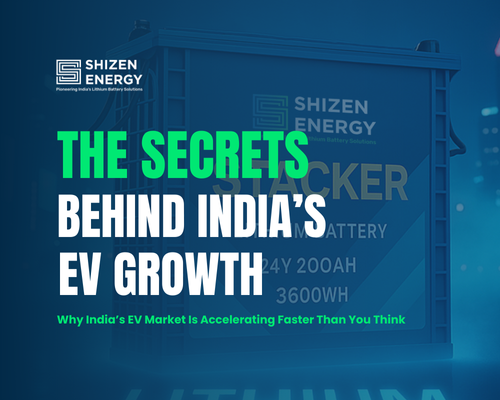
The Indian Electric Vehicle market has reached a critical point. As the country moves forward to make the country greener, more economical and minimize the impact on climate change, the electric car adoption rate in India will become increasingly important.It is of utmost importance for all stakeholders including Investors, manufacturers, government and even the common consumer to identify the present EV adoption status and future market potential in India.
The global electric vehicle battery market is currently majorly dominated by EV Manufacturers, Lithium Battery Suppliers and Automotive OEMs. Shizen Energy India Private Limited is a top electric vehicle battery manufacturer in the Country.
India’s drive to electrify transport is a high-priority national initiative, promising to transform mobility, enhance sustainability, and bolster energy security. This rapid shift towards electric vehicles (EVs), however, brings with it a set of challenges and uncertainties. Understanding where India stands today in its electric transition and envisioning the road ahead is crucial.
This discussion encompasses the current landscape, the future of EVs, including battery electric vehicles (BEVs) and plug-in hybrids, and the burgeoning lithium battery supply chain, to offer a comprehensive perspective on India’s electrification journey. Envisaging the current transition to Battery Electric Vehicles (BEVs), Future Of Plug-in Hybrid, and The Future Supply Chain Of Lithium Batteries is becoming an important need for a successful transition.
Intro duction:
India’s electric mobility vision is ambitious. Government targets, rapid technological progress, and a growing ecosystem of startups and innovators have accelerated the adoption of electric vehicles (EVs) in the country. However, the pathway to mainstream EV adoption in 2024 and beyond is not without its challenges.
From charging infrastructure gaps and supply chain vulnerabilities to policy implementation delays and consumer acceptance hurdles, the journey ahead is complex. This blog aims to shed light on the current state of electric vehicles in India and offer insights into the road ahead.
A critical element powering this electric transition is lithium batteries, the heart of modern EVs. In this exploration, we’ll delve into the key enablers, current status, challenges, and future prospects of India’s electric revolution.
Current Status of EV Adoption in India
Market Penetration and Sales Trends
The Indian EV market has seen exponential growth in recent years. As of 2024, sales of electric two-wheelers, three-wheelers, and passenger vehicles have crossed 1 million, with two-wheelers and three-wheelers accounting for the majority. Passenger EVs, despite being a small fraction of total car sales, are gaining ground, driven by urban adoption and fleet electrification. The government’s goal of 30% EV penetration by 2030 is challenging but within reach, given current growth rates.
Government Initiatives: FAME-II and PM-eBus Sewa
The government has played a significant role in shaping the EV ecosystem in India. The FAME-II scheme (Faster Adoption and Manufacturing of Electric Vehicles) has provided a subsidy of ₹10,000 crore for EV purchases, charging infrastructure, and research & development initiatives. As of 2026, the government has sanctioned over 7,000 public charging stations under FAME-II, although actual deployment is behind schedule. The PM-eBus Sewa initiative, aimed at electrifying public transport, is set to deploy 10,000 electric buses in major cities, further fueling demand for high-performance batteries.
Role of NITI Aayog
NITI Aayog, the government’s policy think tank, has been actively involved in shaping EV policy. Recommendations for a robust policy framework, battery recycling norms, and incentives for domestic manufacturing have been put forward. They have emphasized the importance of local value addition, building a resilient battery supply chain India, and incentivizing investment in indigenous technologies.
Key Pain Points are listed below:
- Hindering Growth
- Charging Infrastructure Gaps
Despite positive strides, charging infrastructure in India remains a critical bottleneck. As of early 2024, over 12,000 public chargers have been reported non-functional, leading to a frustrating range of anxiety and inconsistent user experiences. While urban centers are relatively well-covered, rural and highway charging infrastructure is sparse, restricting EVs’ practicality for many users. Grid capacity and reliability are also a concern, particularly with scaling adoption.
Battery Supply Chain Vulnerabilities
Policy Implementation Delays
India has a suite of supportive policies and incentives for EV adoption, yet their impact has been muted by bureaucratic red tape and slow disbursement of subsidies. Fleet operators and consumers report delays in receiving FAME-II incentives, dampening adoption. A patchwork of state-level EV policies adds to the lack of clarity and consistency in the market.
Consumer Awareness and Trust
A significant disconnect remains between awareness of and intent to purchase EVs. Surveys indicate that only 8% of Indian consumers prefer battery electric vehicles (BEVs) as their next vehicle. Range anxiety, concerns about charging availability, and long-term durability continue to hinder consumer confidence. Education, transparent performance data, and strong after-sales support will be critical in building consumer trust.
Future Potential and Opportunities
Market Projections
Analysts project that the EV market in India will grow at a CAGR of over 40% through 2030, with battery demand reaching 150 GWh per year. Initial growth will be led by two-wheelers and commercial vehicles, followed by passenger cars and public transport. Expansion in the number of EV manufacturers and automotive OEMs will create new opportunities for EV investment.
The Pivotal Role of Lithium Batteries
The entire EV story hinges on lithium batteries. Their high energy density, fast charging, and long cycle life make them ideal for everything from e-scooters and e-rickshaws to e-buses and industrial energy storage. Here’s how battery technology is transforming the Indian EV landscape, and how companies like Shizen Energy India are leading the charge:
- Custom OEM battery R&D for automotive and industrial clients
- Specialized solutions for golf carts, e-boats, forklifts, and electric carts
- Scalable and maintenance-free battery energy storage systems with >2,000 charge cycles
- Strategic collaborations with global leaders to ensure quality and innovation
Advances in battery chemistry, thermal management, and recycling are set to further improve performance and sustainability. India’s battery manufacturing landscape is shifting from lead-acid to lithium in a big way. Lithium batteries are the obvious choice now, offering many advantages, including high energy density, fast charging, longer life, safety, and environmental friendliness.
Investment Opportunities
The rapidly evolving EV landscape presents several lucrative investment opportunities:
- Battery Manufacturing: Set up or expand domestic battery production facilities to cater to growing demand, like Shizen’s 2 GWh facility.
- Charging Infrastructure: Install fast-charging networks, explore smart grid integration, and renewable energy-powered charging stations.
- Supply Chain Localization: Invest in mining, refining, and recycling of lithium and cobalt to reduce import dependence.
- Fleet Electrification: Offer financing and solutions for commercial fleets, public transport, and last-mile delivery operators.
- R&D and Innovation: Invest in startups and research institutes focused on next-gen battery tech and energy management systems.
Stay connected with us on social media for the latest blog updates, tips, and insights.
Conclusion and Next Steps
India’s electric revolution is underway, with the current status of EV adoption in India looking very strong. However, there are many challenges such as charging infrastructure, import dependency, and policy gaps that need to be addressed. In this transition, lithium battery suppliers and electric vehicle battery manufacturers in India are playing an important role.
For customers that need high-performance lithium battery solutions for a wide range of applications, Shizen Energy India Private Limited is the best eV Battery manufacturer in India. We offer custom OEM battery R&D for automotive and industrial clients, specialized solutions for golf carts, e-boats, forklifts, and electric carts, scalable and maintenance-free battery energy storage systems with over 2,000 charge cycles, and strategic partnerships with global leaders to ensure quality and innovation.
To electrify the future with performance, reliability, and scalability, join hands with Shizen Energy India Private Limited. Visit [Shizen Energy India](https: //www.shizenenergy.in) to explore how we can power your transition to a sustainable and electrified India.